

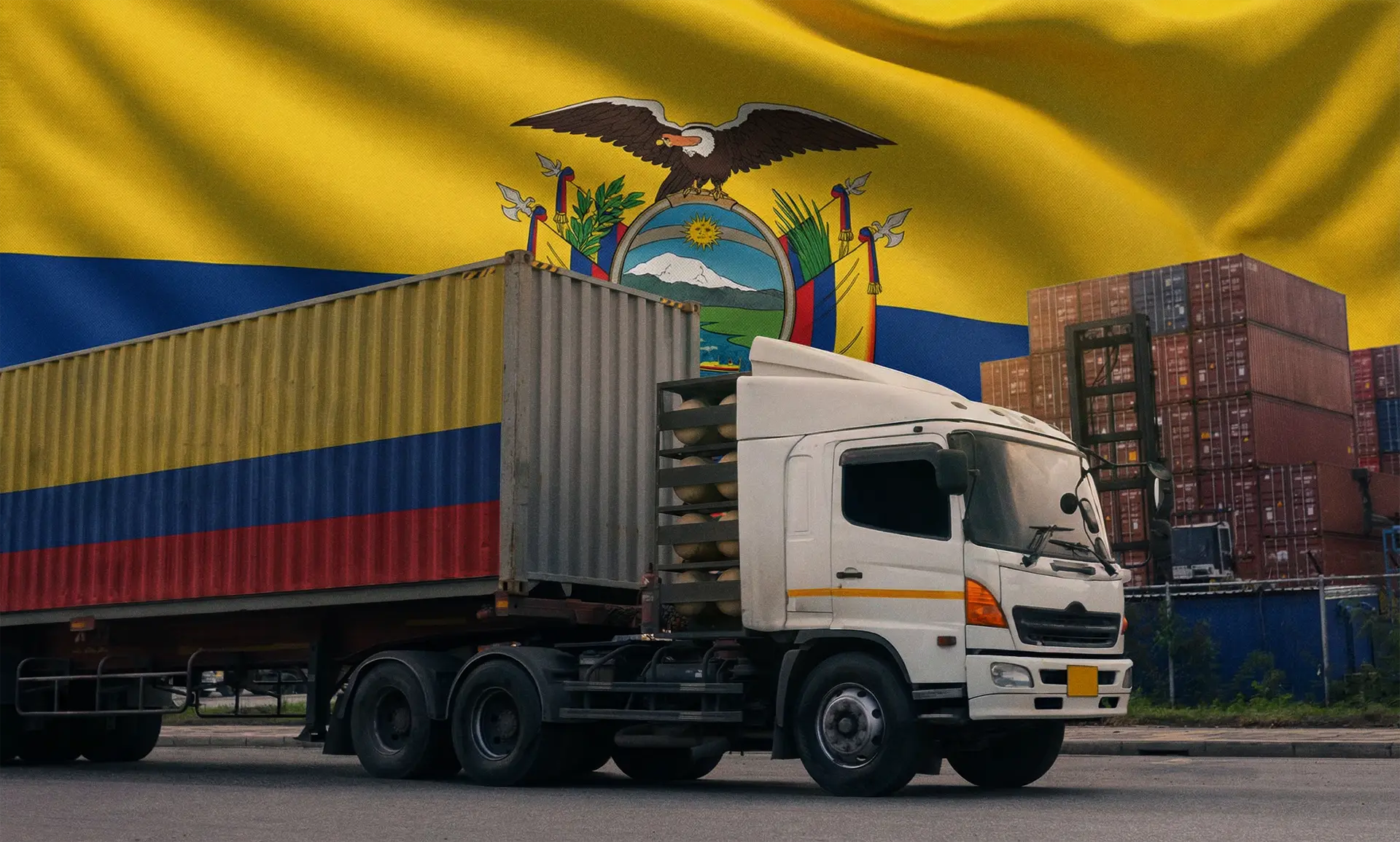
For years, trade between Ecuador and Colombia has followed a particular dynamic within the region. Geographic proximity and the complementarity of certain products have sustained an active exchange that has largely relied on land transportation, with the northern border serving as a key corridor for the movement of goods.
That relatively predictable operation began to change in January 2026.
Ecuador’s decision to impose a 30% tariff on Colombian products, followed by equivalent countermeasures from Colombia, including a reciprocal 30% tariff and the temporary suspension of electricity exports to Ecuador, has introduced a new level of tension in a relationship previously considered stable.
Additionally, Ecuador significantly raised the tariff for transporting Colombian crude through the Transecuadorian Pipeline by nearly 900%, interpreted by logistics and government sectors as a strategic countermove in response to the electricity suspension.
Beyond the immediate commercial impact, the episode places the border back into the logistics equation as a variable that can no longer be taken for granted.
In the short term, effects are not immediately visible in aggregate statistics, but in day-to-day operations. Land crossings have become more cautious, transit times less predictable, and associated costs (insurance, contractual adjustments, and contingencies) are under review. As is often the case, logistics is the first system to absorb changes in the operational landscape.
The inclusion of the energy component adds complexity. Electricity exchanges between Ecuador and Colombia have not been permanent structural flows but have rather served as intermittent resources in moments of need. For that reason, the suspension carries symbolic and operational weight: it injects uncertainty into a resource that underpins key processes like production, refrigeration, storage, and port operations.
Recent reports suggest that the suspension of electricity supply is generating additional costs of around USD 2 million per day for the Ecuadorian system, as it resorts to more expensive internal alternatives.
Colombia has stated that the measures are temporary and subject to review, theoretically leaving room for de-escalation in the short term.
However, the recent expansion of the 30% tariff to 23 additional products by the Colombian government, combined with Ecuador’s response to increase crude transportation tariffs, shows that the conflict has escalated beyond purely commercial grounds. Decisions have taken on a diplomatic and strategic dimension, with direct implications for cross-border logistics.
In this context, logistics takes on a different role. Rather than focusing solely on cost optimization, it now involves managing exposure. Companies must reassess their dependence on specific corridors, evaluate maneuvering margins, and reconsider decisions previously made under assumptions of regional stability. Inventories, alternative routes, and contractual clauses now carry strategic weight they did not always have.
The main land crossing between Ecuador and Colombia, Rumichaca, remains operational. However, since February 1st, it has shown signs of strain. The new tariff regime has not closed the border, but it has redefined the logistics equation: greater uncertainty, more contractual adjustments, and increased risk for those operating in this critical corridor.
In a region where bilateral relations can tighten without warning, and in a world where maritime routes face disruptions due to climate, geopolitics, or bottlenecks, the real vulnerability lies not in the event but in unrecognized dependency. So, even if your operation doesn’t go through Rumichaca, the question remains:
- What critical route are you assuming to be stable when it no longer is?
- How much of your service promise depends on a map that has changed, but you haven’t updated it?
In this context, the challenge is not predicting the next disruption but revisiting how many critical decisions are still based on assumptions of stability that no longer hold.
Logistics is no longer a problem of optimization. More than ever, it is a problem of strategic design.